Tails from the Trails: The First Snowfall
Reading Time: 5 minutes
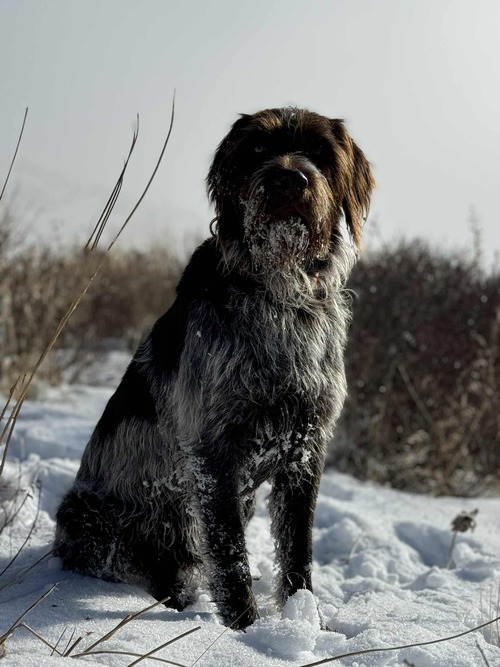
There’s something comforting about the small space of a tent and the warmth of a sleeping bag, or in this case, the two bags I’m zipped snugly into in order to ward off the early-winter chill. I glance over and my bird dog, Godric, is curled up in a ball next to the titanium wood stove that I’ve been stoking throughout the night, an old red wool blanket folded neatly underneath him for his makeshift bed. I packed in several loads of split firewood on the goats for this trip, all now neatly stacked behind the stove, something I’ve found that saves countless hours of camp work otherwise spent breaking down damp branches that make for poor kindling. I’ll gladly trade an hour of splitting firewood at home to save countless hours of busy work in the backcountry.
Late-season hunting in the cold months poses its own set of challenges, and staying warm, dry, and comfortable is a top priority. In contrast with the warmer months, when our trips are light and fast and some comforts can be sacrificed for sparing some weight, these cold-weather trips are spent in the tent upward of 15 hours a day and being unprepared will make you and your goats miserable.
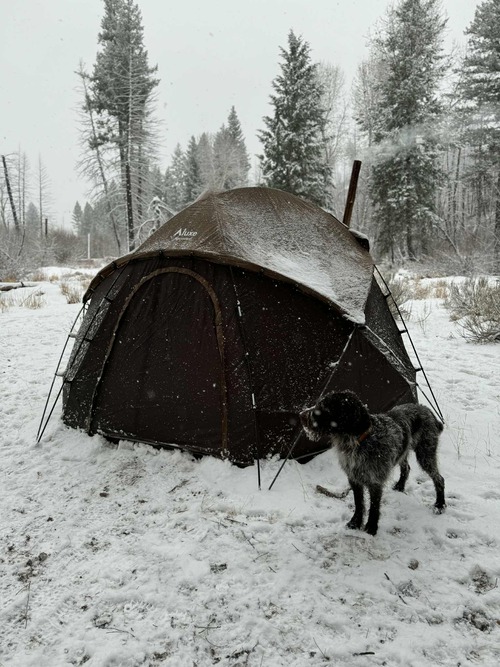
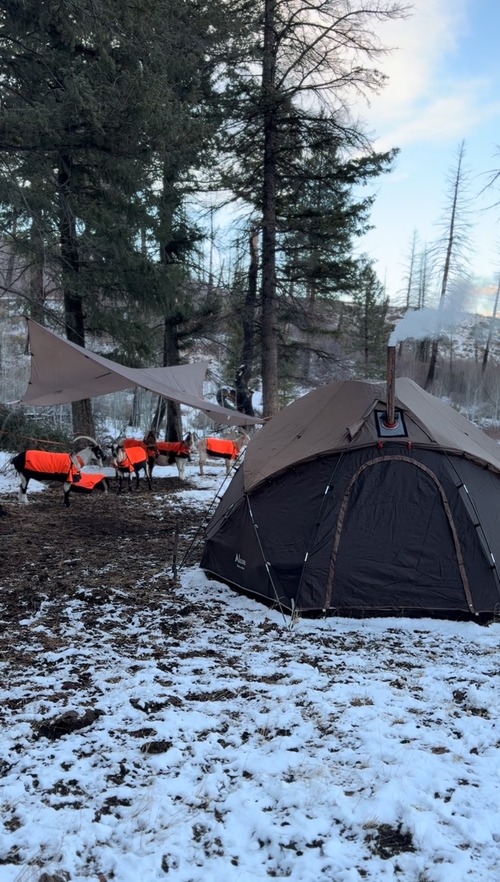
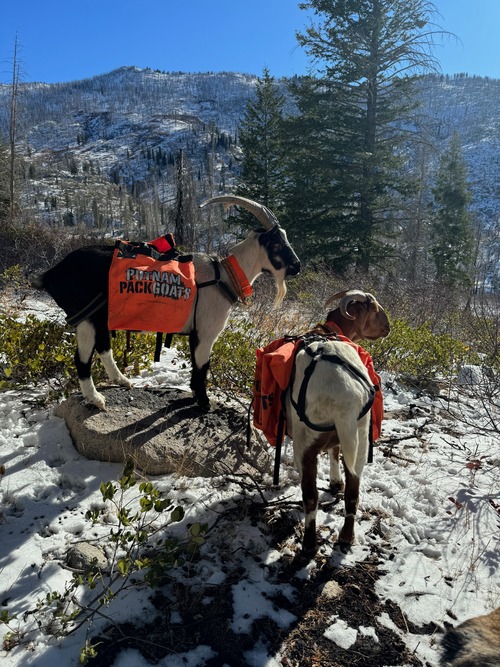
I pop the tent door with my hand before I unzip it, and a thick sheet of snow falls off. I peek outside and am met with more of the same. What was once a small, grassy meadow along a creek, surrounded by a dense thicket of looming ponderosas, has been transformed by a blanket of powdery snow. The six goats I’ve brought with me are less impressed, low-eared and huddled together on their high line, crowding underneath every available inch of the Kelty Noah’s 16 Tarp that I’ve hung in a diamond shape over them. The snow has weighed it down to the point where it grazes the tips of their horns, something I’ll need to correct later by raising the tarp’s main line another few feet. Truthfully, I’m less worried about them in snowy conditions than in heavy rain, as a good shake will shed most of the snow from their bright-orange jackets and also serve as some protection from the wind. A small piece of comfort that I can afford to give them on these frigid trips.
I strip their jackets and replace them with saddles, and as I turn each goat out there’s a renewed energy throughout the group as they gallop and playfully spar with one another in the fresh snow. I’m mindful of the order in which I release them because a few antagonists like to harass the ones still tied up. Titan, my big Alpine, is notorious for this, so he gets let off last and rushes to join in the fighting, anxious to settle grudges and create new ones.
I’m the last to get ready, and I shed a few layers of heavy wool and place them in my pack. Layers are something I carry myself, as it’s easier to shed or add them at my own leisure without digging through a goat’s pack and throwing off its balance. Lastly, I check my shotgun —a compact 20-gauge over-under I like for these trips that swings up quickly and breaks down for easy storage. I’ve added a custom extension to this one to increase its length of pull to match my taller frame. At the sight of it, Godric is bursting with excitement and tears circles through camp, all the laziness of the morning shed in an instant.
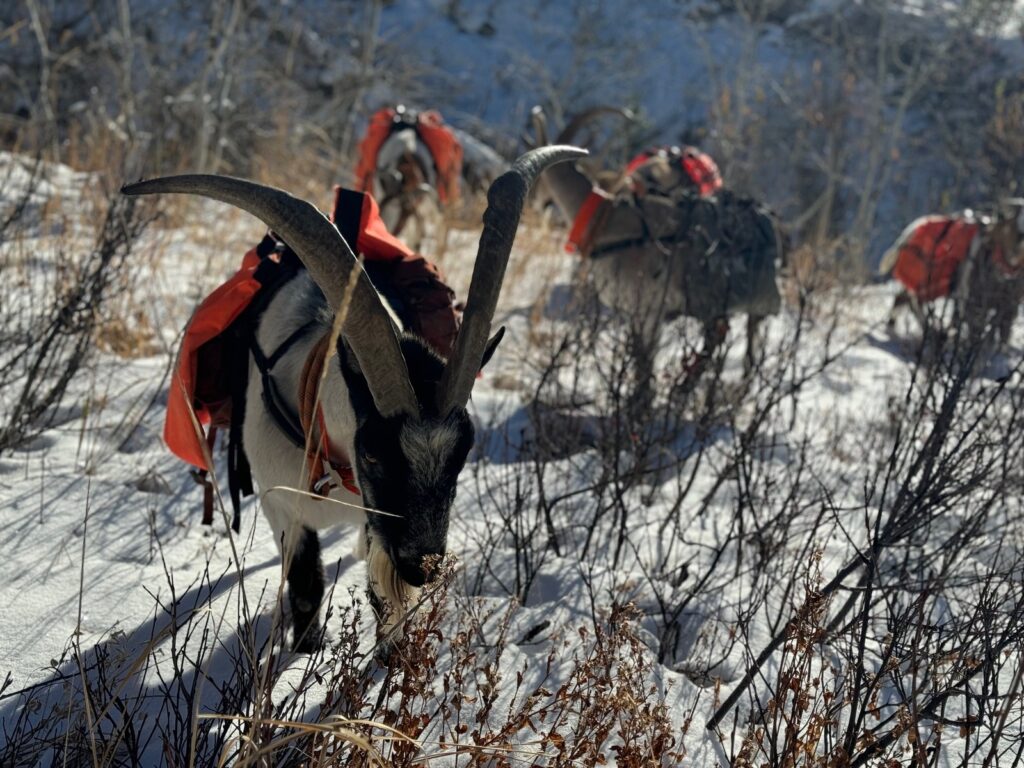
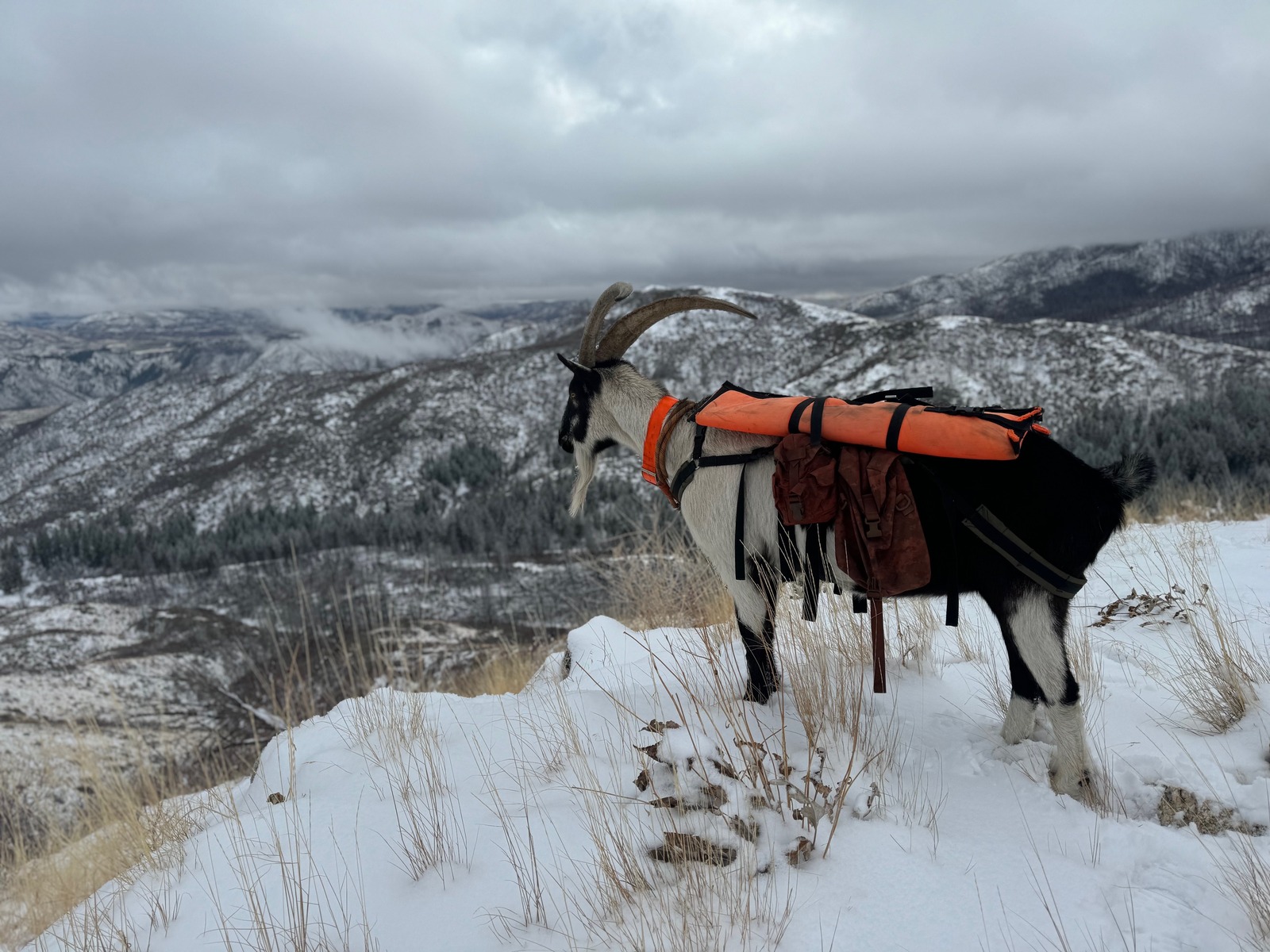
I whistle for my goats to follow, and we’re all trudging through the snowy trail along the creek, stopping occasionally for them to snack on what little graze is available. On these trips, it’s especially important for them to forage to keep their internal furnace going, but I’ve also packed in alfalfa pellets for them back at camp. I feed about 10 pounds a day to six goats, which I’ll drop before tying them up for the night. For late-season trips, I keep my string numbers small because the more goats you bring in, the more feed you need to pack. On trips like these (where I can’t recall the last time I felt my toes after a few days), about 40 pounds for four nights is enough, which I’ve weighed evenly into small dry bags that help weigh down the inside of my tent until use.
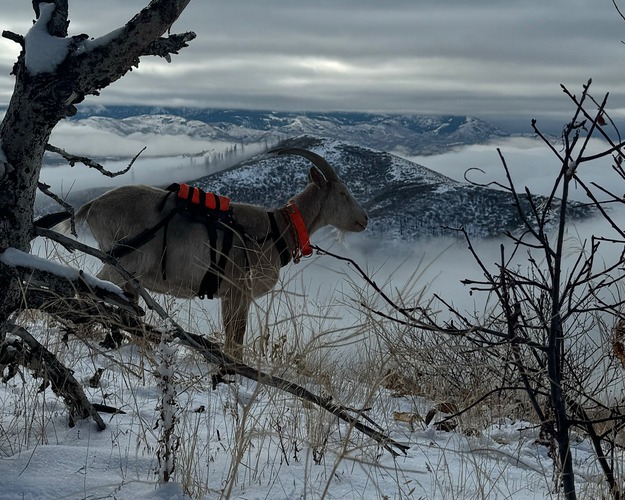
Fresh tracks litter the trail ahead of us, cutting and crisscrossing in all directions. This area is a wintering habitat for deer and elk as the cold temperatures push them off the taller peaks, but the abundance of smaller tracks from rabbits and coyotes — as well as the occasional wolf or mountain lion — is a reminder of who we share the mountain with. Godric inspects these as we go; the rabbits pique his interest, but I pull him off their scent.
We cut off the trail and head up a gentle hill littered with sage and bitter brush that has escaped the brunt of the snow, and the excited buzz of his tail tells me we’re onto something. As he methodically works the hillside, the goats creep behind him, picking up on his mannerisms and cautiously creeping themselves as he carefully selects each step. A sudden halt and a hard lock on a bush tell me to prepare myself, and with a startling flutter of wings and feathers, a covey of Chukar bursts out, and with a quick shot, one falls.
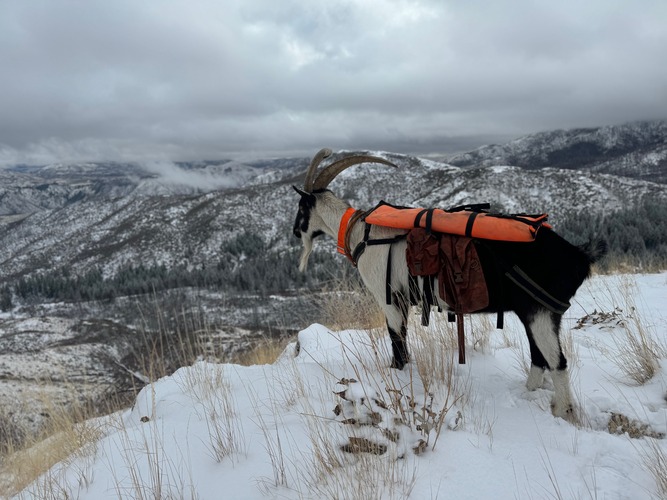
The goats startle at the shot but are easily coaxed into continuing, something I’ve worked on with them since they were babies by shooting targets out in the back of our pasture, as I would with a gun dog. We continue to work the hillside, kicking up a few stragglers, and with some luck, I knock down another. Godric eagerly runs down the hillside to retrieve it and returns to me with his prize. With the thrill of the hunt over, we quickly descend back to the trail and return to camp with some wild game for the dinner pot.
NATHAN PUTNAM is a board member of the North American Packgoat Association. He and his wife, Jackie, own Putnam Pack Goats in Mountain Home, Idaho, where they breed SaberPine crosses and build pack goat equipment. They enjoy hiking and hunting in the Idaho backcountry with their goats. You can learn more about them at putnampackgoats.com or on Instagram @putnampackgoats.