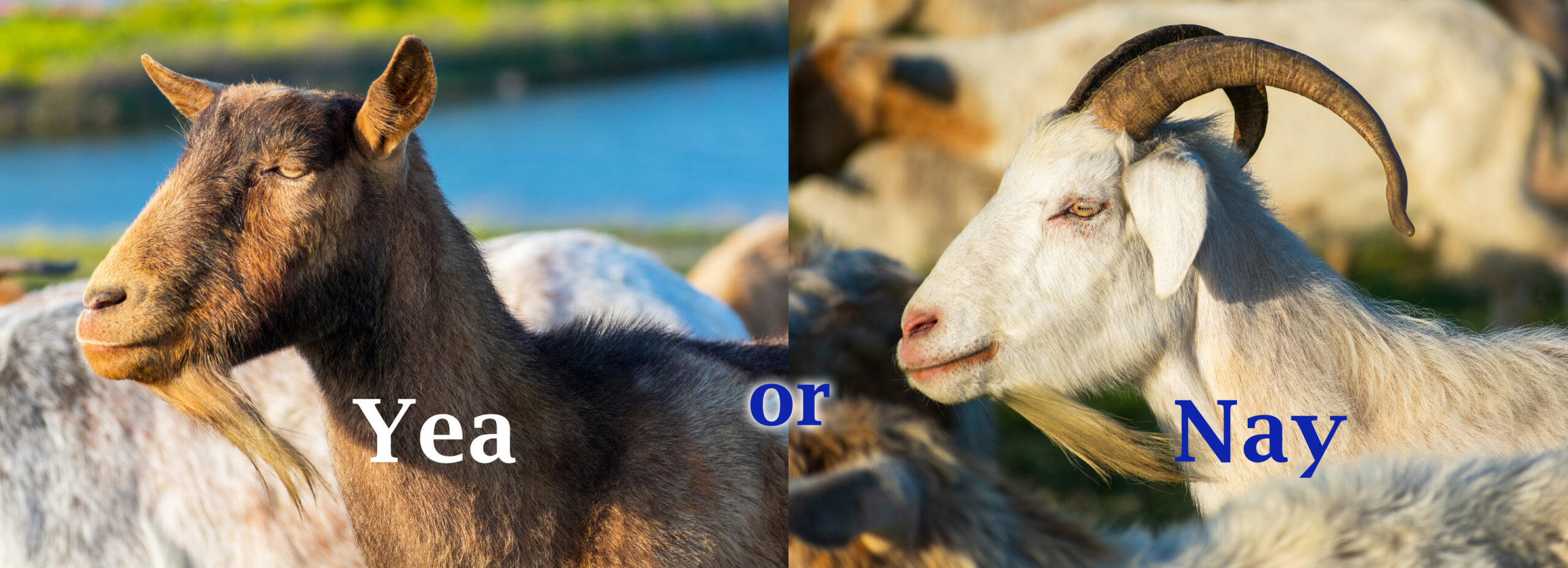
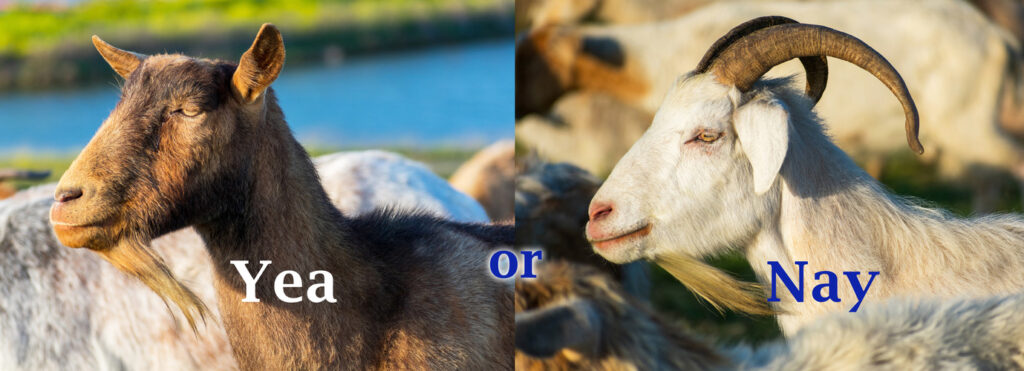
Reader Response: Disbudding – Yea or Nay?
Reading Time: 8 minutes
Disbudding is often a contentious topic among goat keepers. We reached out and asked: Do you disbud your goats? Why or why not? We had over 300 responses ranging from humorous to cantankerous. While we would have loved to post them all, there isn’t room and, quite frankly, some weren’t suitable for repeating. However, we brought a good cross-section of some of the best responses for both yes and no. There were many more great responses that we didn’t have space for.
Yea — Jasmine Entz
Yes, we do. We have dealt with injuries to us and goat kids, abortions in does, stuck goats, damage to buildings, fencing, and equipment. We have paid the vet bills for injuries to others, and self-inflicted injuries like snapping horns off.
We show, so we can’t have horns, but we started disbudding prior to showing. It takes mere seconds — they’re back on mama and never look back.
The temperature regulation isn’t an issue in our area, but I’m also a firm believer that they don’t make or break the self-regulation … Polled goats get by just fine! And the other argument I hear a lot is protection against predators — as a herdsman, it’s my responsibility to keep them safe. Proper fencing, LGD, lock them in at night, etc. I’d never expect them to have to fight off a coyote.
Ultimately, it’s a personal choice; I don’t judge people for keeping horns if that’s what they prefer. I don’t understand why so many horn-preferring people feel the need to insult and judge those who disbud. Manage your herd to what works best for you; leave others alone.
Nay — Gudrun Krause
I don’t. Horns help regulate their temperature. It is also a way to defend themselves. I rescue goats, and not once have I ever been injured by one with horns. Bitten, yes. Pushed yes. But never head butted, and I had some severely neglected, angry, and scared goats. Some get stuck in fences, but then you just figure out how to alter the fence and do it. My neighbor has a dog that is really vicious. He killed three of my goats so far. Yes, animal control was called, and they have done absolutely nothing. All three goats had no horns. He doesn’t go after the ones with horns. I didn’t dehorn my cows either. For the same reason, we have bears, a cougar, and dogs in the neighborhood. It is important to me that they can defend themselves, even if it’s just a little bit.
Yea — Robert McMannamy
Years ago, while judging a fair in Montana, a younger goat with horns approximately 4 inches long came up with its head and accidentally hit a small child in the forehead. As you can guess, the child drops to the ground crying. A bit later, the poor kid starts yelling, “Mom, I can’t see!” The child later recovered ok. But can you imagine if that had gotten him in the eye?!?
Not to mention getting stuck in feeders and fences! So yeah, I disbud my goats!
Nay — Wildwood Farm
I don’t show or sell registered goats. I live in the woods, so my goats need the additional ability to defend themselves. I find disbudding with an iron horrible. And I prefer the look of the goat with horns.
Yea — Crystal Hart
I thought I’d throw my 2 cents out there. Animals in confinement have different needs than those in the wild. Horns in the wild are a beautiful thing. Injury and even death are common when goats are fenced in, to themselves and to other animals with them. Because we disbud, we can run a goat snuggles program that allows the goats to happily and safely cuddle adults and kids of all ages, go into nursing homes or living rooms, and bring joy to people. They are super happy to get all the attention. We also run a dairy and show them, and our goats have lived in 120 degrees F temperatures and never had a problem staying cool in the shade we’ve provided. They have lived near coyotes, mountain lions, and other predators, and our LGD kept them safe, as well as us locking them in at night. The bonus to disbudding is that since we began doing it, I’ve never had a goat get its horns stuck in a fence again, and I’ve never had to rush an animal to the vet because of a horn injury.
Disbudding injuries are super rare to non-existent if the equipment is kept up properly. Tips should be filed or replaced often. We also go the natural route, and give them colloidal silver for a week or two after, as a natural antibiotic to avoid any unforeseen infection or anything.
Nay — Ken Paddack Jr.
No, I need the handles to drag them out of the chicken feed for the 22nd time of the day.
Yea — Wiley Riley Feathered Ranch
Yes, we do for quite a few reasons. The first reason is that my son is disabled, and he does not see very well, along with some other issues, and he absolutely loves to help. He loves the goats. I would hate for one of the goats to hook him by accident.
We also do it for their safety. I don’t know if it’s just my group or if it’s goats in general, but they will find whatever they can to unalive themselves, if it’s not messing with each other, head-butting, playing, or just thinking they can get their head in an area that they should not be, usually the fencing. You know that they are the strangest, funniest, sweetest, most mischievous, get themselves into any predicament goat.
Nay — Melessa Moor
We do not take their horns off. I could not stand the sound of them doing that to my babies, and that’s when you have to do it, but they itch their backs with their horns. They are happier, I believe, and healthier. My goats are free-range, so they are all very tame. And I had a buck that was polled that broke all my fences — no way to keep him in, and he had no horns.
Yea — ReaAnn Allen
Yes! After losing four young doelings and one buckling last summer in less than an hour because they got their heads stuck in midday 100+ degree F heat, we decided that in 2025, we would be disbudding.
Nay — Julia Demskie Harrington
I did some homework before making the decision to keep their horns. I decided it was likely painful, too risky health wise — as you are literally burning a hole in their skull, and inhumane. I have 4 Nigerian Dwarfs, and they use their horns to scratch an itch and play with one another. They have never used them against people and love a good scratching between them!
Yea — Anjou WesCo Farms
We have a mixed herd: horned, disbudded, and polled. We are trying to breed for polled. If I had known how much damage a horned goat can do to fences, other goats, and ME, I would have disbudded all my horned goats. I have one who is a bully. She’s hurt me several times trying to get to her feed or get out of her stall. I would de-horn her NOW, if there were a safe, inexpensive way to do it. I will never NOT disbud again. I’ve also seen all my horned goats get stuck in fencing, purposely tear up fencing, and headbutt other goats. So, yes, I disbud!
Nay — Bleating Falls Ranch
No! For several reasons. The first being that it helps them regulate their body temperature. Another is ease of handling. Another is that it’s their main defense system. We have a few naturally polled that made the cut, but most of ours are horned. To me, the horns make them look majestic.
Yea — Heidi Hertsche Hungerford
It’s going to depend on your market. Registered dairy goats headed to show must be disbudded. It’s easier to find pet homes too. Personally, I don’t want a horn in the eye when I milk, and mine get their heads stuck enough without them!
Nay — Amanda Sherry
Nope. We don’t have the tools or setup to do that. Horns don’t bother us. We have a polled doe that gave us a polled buck, and he has given us more polled bucks.
Yea — Michael Schirtzinger
Market wethers yes, both meat or dairy breeds. For 4-He-rs who don’t work with them nearly enough, it’s for the safety of anyone who has to handle them. Meat does: no. All dairy bred: yes. Breed standards, herd management, and herd health all play a role.
Nay — Two Willows Homestead
No, we do not. We are strong believers that they have them for a reason (to help them regulate temperature, as part of their sinuses, and for protection), so we keep anything born on our farm unaltered. We do have a couple that came to our farm disbudded.
Yea — Courtney Rust
We disbud. I originally decided against it. But here’s the thing: They aren’t being raised in the wild. They are in confinement. I would love to be raising them on hundreds of acres, where demands would be different, but I need to be able to give them better care, which involves interacting with fencing, feeders, and humans on a daily basis. So in order to give them the best care possible in containment, I disbud. I have one horned goat and we have to cut him out of the cattle panel at least once a week. I also have children that I want to be active with raising livestock. I was sitting on a hay bale, and a horned goat jumped at just the right time in just the right way that the horn went right into my eye, but I had glasses on. If that had been anyone else in my family, who knows what the outcome would have been. Disbudding them allows us to be much more hands-on and give them a higher quality of life with better longevity. If I ever get that money tree to shake and find myself on hundreds of acres, I’ll revisit this decision.
Both — Tami Bauer
Disbudding is an awful job, and many people say disbudding is bad. Those people probably haven’t dealt with severely punctured udders due to pointy horns. It’s awful! I’ve gotten my only black eyes from horned goats. I’ve lost goats to getting their head stuck in the fence and me not getting to them in time. I’ve seen them break their necks due to horns in the fence. I was walking over to extract a buck, and he pulled back wrong; and I heard his neck snap. They can be fairly self-destructive and creative in their attempts to die. Horned goats are dangerous. To themselves, other goats, stock, and humans. I’m definitely not saying all goats should be disbudded. But it has its place and can save them in the long run. I’ve also seen kids die from botched disbudding. (Not my job, but a well-experienced friend’s job). In most cases, milk goats and pets should not have their horns — the risk during disbudding is small, and the pain is only momentary. In many cases, such as range goats, horns are a need and a protection. For the record, I have both.
My Nubian herd and LaMancha herds are all disbudded. Safety for them not damaging udders, and staying out of fences are top reasons for me. Also, a horned milk goat is worth way less than its disbudded counterparts in my area, mainly due to the dangers already mentioned and, if you want to show, they must be disbudded in the milking breeds.
My Boer herd is a range herd, all have their horns. I have lost them to getting stuck in the fence. It’s rare, but it does happen. The conformation of the Boer horns and the smaller udder capacity in my herd make it safer for them to have horns and not poke holes in each other. They use their horns to protect themselves and pull stuff down to browse. Each and every goat herd has reasons for disbudding or not disbudding. In most cases, if not all cases, the decision is made to give the goat the best life possible. As mentioned, I do both, as that protects my animals in their respective herds.
A Reminder
Kennon Kamp Farm wanted to remind everyone that disbudding and dehorning (those terms were occasionally being used interchangeably in the comments) are two very different things. And they’re absolutely correct, and no, the terms aren’t interchangeable.
Disbudding — Preventing the horns from ever developing by destroying the horn buds in very young goat kids (less than two weeks old) before the horn buds are connected to the skull. The practice is personal and depends on each farm’s situation.
Dehorning — The surgical removal of fully formed horns, which almost everyone agrees should be done only in an emergency, by a veterinarian, and avoided if at all possible.