Harvesting Goat Milk
Reading Time: 9 minutes
Let’s talk about harvesting delicious and nutritious goat’s milk for drinking and making dairy products. If you want to know more about the needs of the goat during breeding, pregnancy, and delivery (all the stages it takes to get to the milk part) please consider referring to Chapter 8 of Holistic Goat Care. On page 20 earlier in this book, you’ll find some facts and myths about goat milk.
Commercial Versus Home Production
There’s quite a difference between producing milk strictly for home use and producing it for commercial sale. In almost every state in the United States and in many parts of the world, milk and dairy products cannot legally be sold or shared with those outside your immediate family without regulatory oversight. If you are interested in having a commercial dairy, know that almost no other food industry is as regulated as is the dairy industry. The decision to become a licensed dairy (making and selling fluid milk) or products producer (making and selling cheese, butter, or yogurt) brings with it the need for a deep understanding of regulations and requirements. I’ve dedicated two previous books to this topic if a deeper dive is of interest to you.
Milking Basics
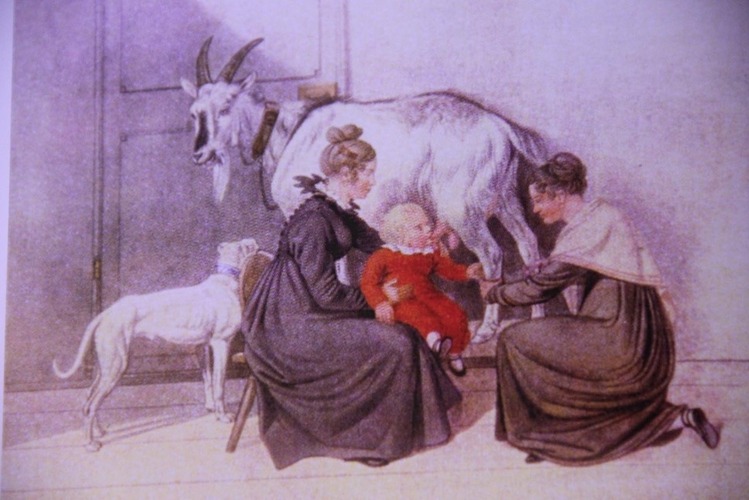
High-quality goat’s milk comes only from healthy, well-nourished, and unstressed goats. The task of milking must also be done properly in order to preserve the quality of the milk. There is a saying that I like to repeat that should help you to understand how tricky maintaining that quality is: “Milk was never meant to see the light of day.” Think about it: nature designed milk, from all mammals, to go directly into the baby’s mouth and then stomach. Every step we humans add in our efforts to preserve it for later use adds a layer of reduction in quality and even possibly makes it unsafe. Here are the keys to ensuring you have the best possible milk supply. Please remember that the licensed and inspected facility will have a much longer checklist of requirements. For a deeper dive into all things milk-production related, please consider my book The Small-Scale Dairy.
- Healthy goats that are tested for every known disease passed in milk to humans.
- A clean place to milk that’s separate from exposure (particularly during milking) to dust from pens, manure piles, and feed; is easy to keep clean and is kept clean; is well lit; and has hot and cold running water. (Inspected facilities will have a more extensive list of requirements.)
- Milking equipment that is in excellent condition and can be kept immaculately clean.
- Clean animals entering the milking and haven’t shared barn space with pigs or poultry.
- Healthy and clean people who do the milking.
- The ability to quickly chill the milk to the proper temperature and keep it cold.
Milking Preparation
Fortunately for those of us wanting to milk goats, the process is helped along by the fact that goats are naturally fairly clean, especially when compared to cows. Their dislike of water and the fact that their manure is dry means that goats come into the milking parlor likely cleaner than their dairy cow cousins. This means that there is less work preparing them for milking and less likelihood of milk contamination with manure.
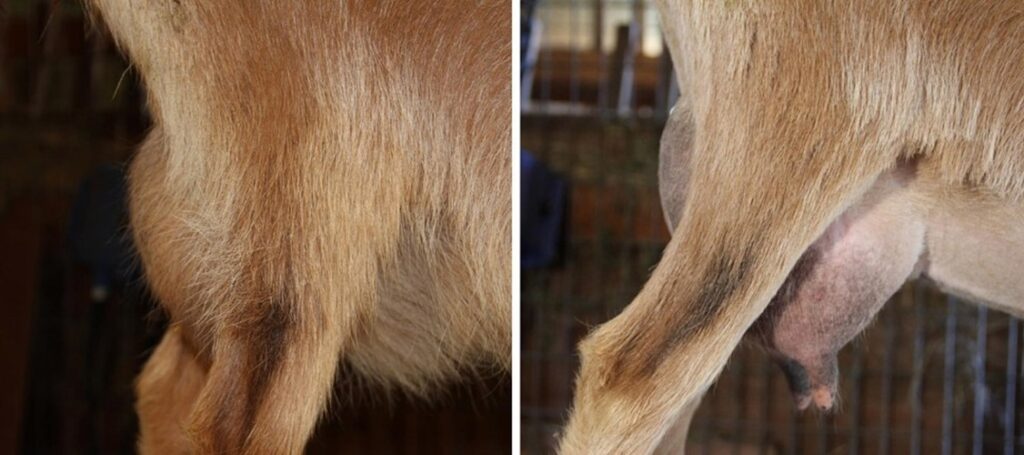
To further increase the ease of collecting clean milk, you can clip the hair from the goat’s udder, belly, and flanks—called a dairy clip. The dairy clip should be updated periodically and goes a long way toward increasing the cleanliness of the milk by keeping dust and debris from entering the milking pail or being drawn in through the milking machine’s air vents. (A milking machine system is not closed! It suctions a tiny bit of air into every line in order to not create a vacuum where milk would not flow readily away from the animal.)
Once in the parlor, the udder should be lightly cleaned with a moist, not wet, cloth. A soapy solution can be used. It’s critical that it not be dripping wet, as any moisture running down the udder could drip into the pail or be drawn into the milking machine teat attachments. The soapy solution is meant to clean away any debris and the rubbing will stimulate the letdown response of the doe so that she relaxes and releases her milk more readily.
Once letdown has begun, the first milk, called the foremilk, is removed by milking three to four squirts into a bowl or specially designed cup, called a strip cup. This helps flush out contaminating bacteria that will have invaded the teat during the interval between milking. Observe the milk for abnormalities such as clumps, blood, or mineral crystals that could indicate an udder infection (mastitis). Every month, or more frequently, the foremilk should be checked for somatic cell count (skin and white blood cells) by using an on-farm test. Some of these cells are always present, but a spike or chronically high number is indicative of a problem. I like the California Mastitis Test (CMT). It’s simple, inexpensive, and effective. By doing this type of test regularly, you are likely to catch mild udder infections while they are still treatable without needing to use antibiotics. See the section on mastitis in Holistic Goat Care for more.
After the foremilk has been removed the teats can be dried with individual paper or washable cloth towels. It’s always important to milk with dry hands and dry teats—even when using a machine. When either is wet, the likelihood of spreading bacteria from animal to animal or into the milk goes up. When a machine is used, the wet teat can cause the milking attachment to slip and irritate the teat or allow milk to be pushed up into the teat, leading to trauma and possible infection.
Milking Technique
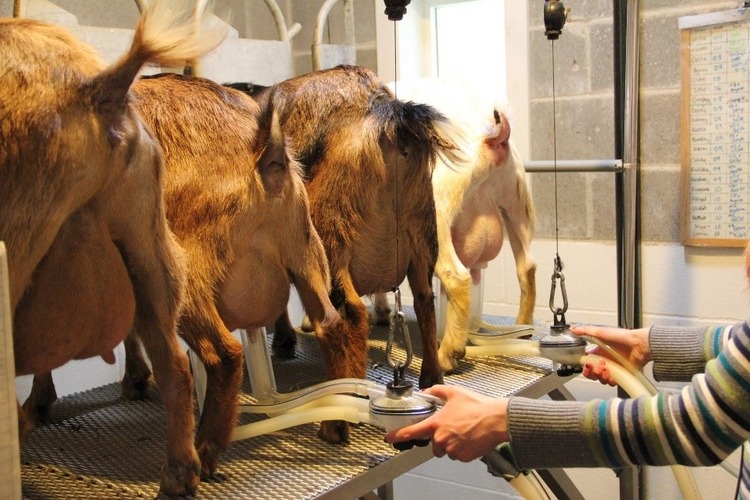
Hand milking is a skill that takes a few days to master, but once you do, you will gradually increase your speed and skill to equal that of a milking machine. A milking machine is a good choice when many goats must be milked and, when equipped properly, allows for multiple goats to be milked at once. The cleaning and maintenance of a milking machine takes time and an understanding of how to use the right cleaners and sanitizing solutions. (If you are considering setting up a system for a commercial dairy, in-depth information on that topic is covered in TheSmall-Scale Dairy.) There are some inexpensive setups that look a bit like a hand-pumped milking machine and promise ease of milking, but the physics of the way most of these work on the teat are often not good for long-term use as they don’t allow for good blood circulation in the teat.
Hand milking traps milk in the teat using your thumb and first finger and then gently pushes it out of the teat orifice—the opening at the bottom—with your other fingers. Machine milking uses vacuum pressure turned on and off by a unit called a pulsator to remove milk. The vacuum mimics how the kid nurses a bit more than hand milking does, so when the vacuum is set to the right suction level and the attachments fit well, it is quite comfortable for the goat.
The Changing Paradigms of Dairy Sanitation
A common practice is to pre- and/or post-dip teats in a sanitizing solution, but recent data is showing that with a healthy udder this is not only unnecessary, but destroys protective skin flora on the teat. It’s still used a lot though, particularly in high-turnover dairy parlors where workers can only take seconds to prep an udder. At home and in small dairies, more time is usually available to make up for what the chemicals can do with thorough cleaning by hand.
Milking Equipment and Cleaning
Milk should be collected in a stainless-steel pail or bowl. As soon as the milking is completed, the milk should be poured through a milk filter (usually a disposable paper mesh, but sanitized cloth of a tight weave can also be used) and into thoroughly cleaned glass jars. If the milk cools too much before filtering, the fat globules in higher-fat goat’s milk might solidify and clog the filter. After pouring the milk through the filter, it should be inspected for abnormalities in the milk—the same as those you look for in the strip cup.
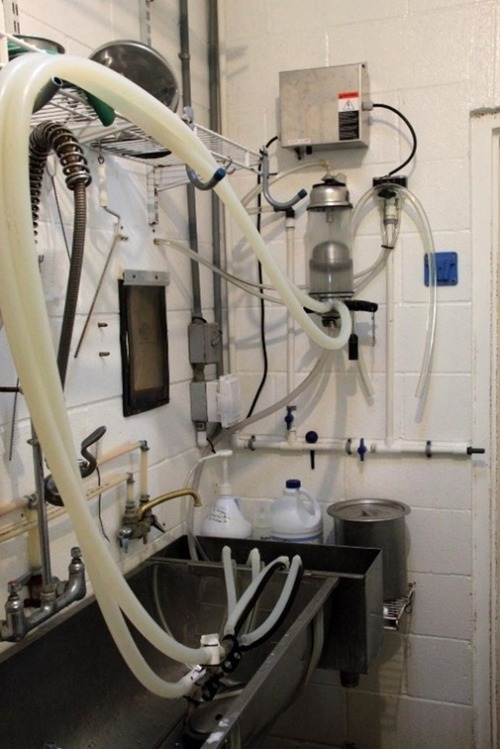
All milking equipment and storage containers should be kept immaculately clean. Immediately after milking, rinse all equipment with lukewarm water, then wash and scrub in hot soapy water and rinse well and set to air dry. An automatic dishwasher does a fine job cleaning hand milking equipment. Just before the next use of the equipment, it’s a good idea to sanitize all equipment and containers with either boiling hot water or a properly diluted sanitizer. Bleach is commonly used, but is very hard on stainless steel, causing pitting if it’s too strong. The usual recommendations, including those recommended by household bleach companies, create a solution much stronger than needed, but err on the side of caution. If you want a more proper dilution, you can buy chlorine test strips to verify the strength. Our dairy inspector said that a proper dilution smells reminiscent of the scent of a chlorinated swimming pool. When properly diluted, you don’t need to rinse off the sanitizer.
Cooling and Storing
Quickly cooling milk from the temperature at which it leaves the goat, from right about 100 F (38 C) to refrigeration temperature, at or below 40 F (4.4 C), within two hours after milking is finished is critical for milk safety and flavor. Goat’s milk is particularly prone to flavor changes that leave it smelling and tasting a bit like the aroma of a buck. When it is very clean and chilled quickly the flavor should be crisp and clean, with no barnyard or buck flavors. Setting the jar in the fridge isn’t an effective way to chill the milk. Small jars, under 1/2 gallon (500 ml), can be chilled in the freezer. Shake it once or twice during chilling to help it chill evenly. You can also set jars in a sink or tub of ice water. Be sure to stir or swirl the milk as it chills. When you first start figuring out how to chill your milk, verify that the temperature goal is achieved by checking it with a thermometer.
Commercial dairies have the same chilling goal, but usually accomplish it by pouring the milk or pumping it into a chilling unit called a bulk tank. The bulk tank stirs and chills the milk as well as records its temperature for the dairy inspector and dairy farmer. Like milking machine equipment, chilling equipment requires a great deal of cleaning and knowledge about maintenance.
Can You Freeze Goat’s Milk?
When foods reach freezing temperature, the water molecules begin to form into crystals. The longer it takes for the substance to become completely frozen, the larger these crystals grow. As they grow, they damage solids around them. Take for example fresh fish: when frozen at home, then thawed, the flesh is often mushy from the resulting damage of ice crystals. Milk is no different. The solids, the milk-fat globule membrane and the proteins, are damaged during freezing. That being said, the faster milk can be brought to 0 F (18 C), the less damage will be done. In addition, “low-water” milk (basically milk that is naturally higher in fat and protein like Nigerian Dwarf and Nubian milk) has a better shot at successful freezing simply because there is less water.
To accomplish proper freezing at home without commercial flash-freezing equipment, pour the milk into a shallow container (a freezer bag works well), lay on a tray, and place at the lowest available level of a chest freezer set to its lowest temperature. Although milk can stay frozen for long periods of time, the less time it spends this way, the less damage will occur.
When you thaw the milk, if you find it clumpy or gritty, then you know damage has occurred.
Excerpt from The Useful Goat: The Ultimate Guide for Milk, Meat, Fiber, Hides, and More (a companion to Holistic Goat Care), by Gianaclis Cadwell.
Bio: Gianaclis (gee-on-a-klees) Caldwell is also the author of Holistic Goat Care, Mastering Artisan Cheesemaking, Homemade Yogurt and Keifr, and several other titles on small-scale cheese and dairy. She also writes speculative fiction; her first novel, The Binding, is available in print, ebook, and audio on all platforms. As the owner and cheesemaker at Pholia Farm (2023-2024, when the farm was sold), she grew to love and respect goats as the most amazing livestock and companions. You can contact her at gianaclis@gmail.com, subscribe to her newsletter on her website at gianacliscaldwell.com, or connect with her on Bluesky.