Witnessing an En Caul Birth
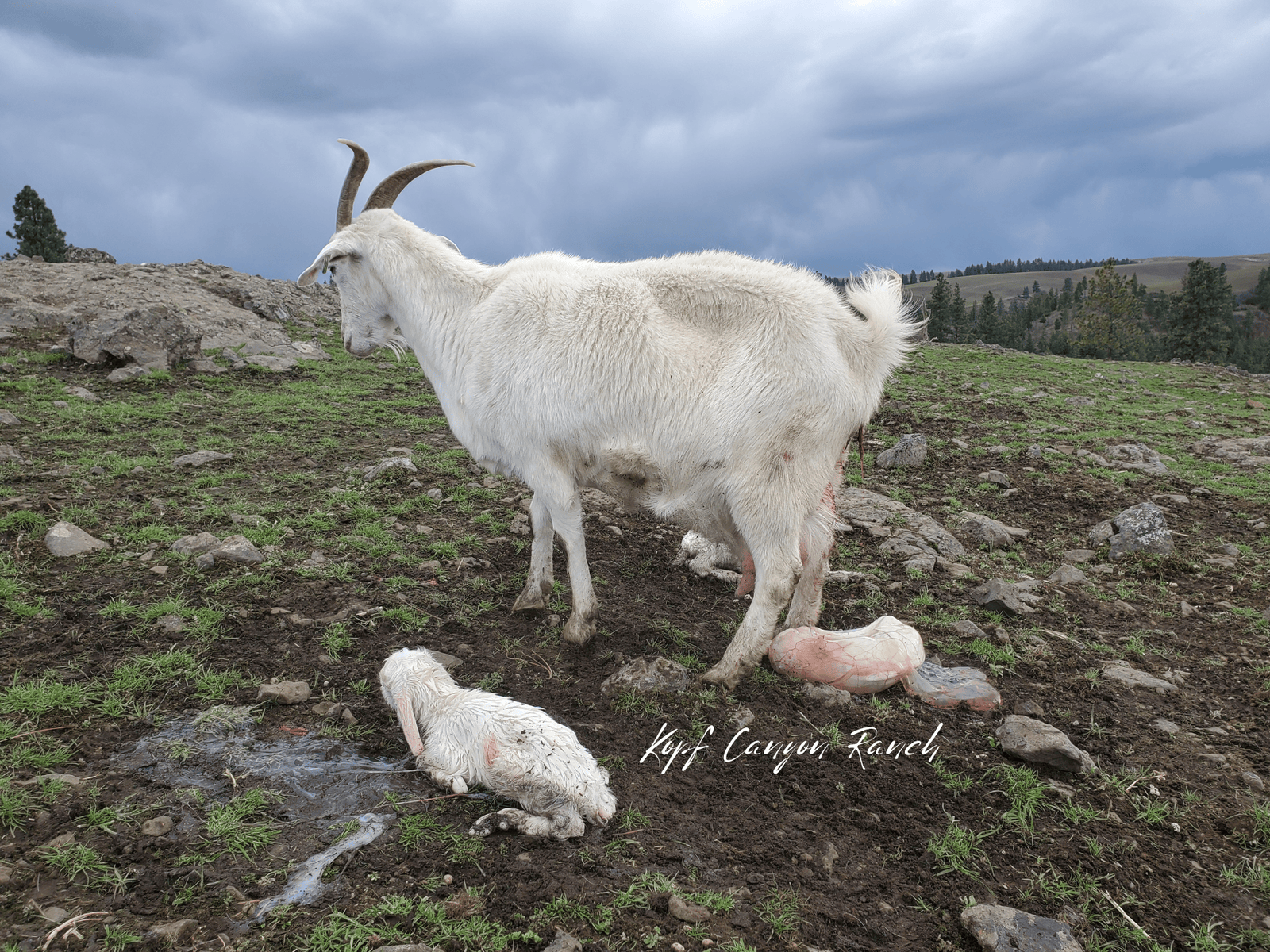
En caul refers to the birth of a fetus entirely encased in an unruptured amniotic sac. It’s not an emergency, it’s normal in animals. In that moment, we’re given a rare glimpse of the baby’s life inside the womb, suspended in fluid, unaware that it’s been born.
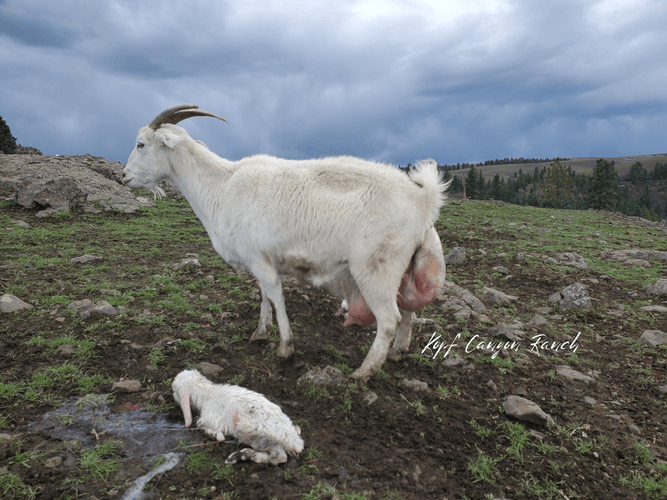
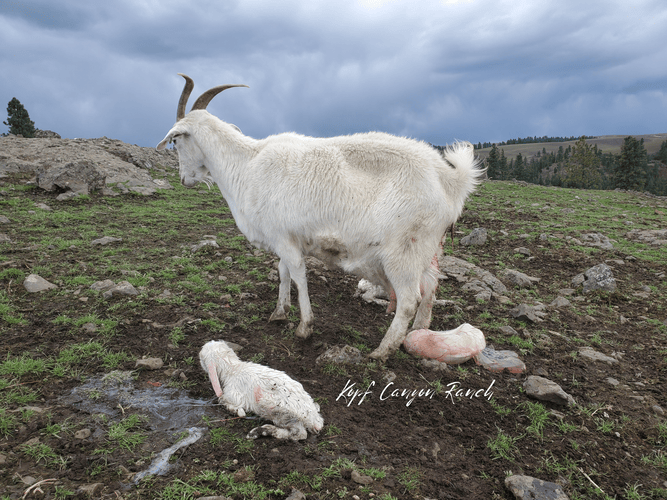
If we’re present, we just watch, unless there’s difficulty. Because the amniotic membrane in livestock tends to be thicker than in humans, caul births tend to be more frequent, though no concrete data exists (Merck Veterinary Manual, 2023). It isn’t unusual at all for us to see the amnion (the thin membrane forming a closed sac around the fetus) as the first presentation showing imminent birth with goats, rather than “water breaking,” as reported by most women. An intact sac can help cushion the delivery of a newborn to animals born standing up — or in the case of our doe, Kopf Canyon Crocus — delivering standing up on rocks!
A caul birth isn’t an emergency, but the breaking of the umbilical cord without a clear airway is. Once the umbilical cord breaks, the baby is no longer receiving oxygen and must breathe air, so the sac needs to be opened or the baby will drown or suffocate.
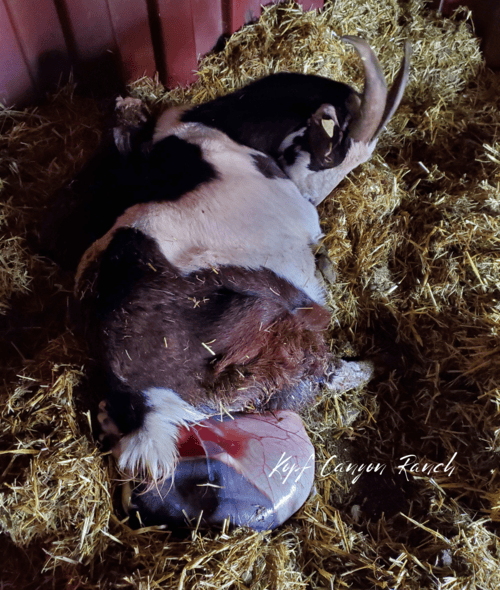
It’s standard practice in assisted births to break the membrane and clear the nose as quickly as possible. In unassisted births, the doe is expected to do this instinctively. If a deceased kid is found en caul, it isn’t always a result of maternal neglect. A less vigorous or nonviable newborn may not effectively stimulate a maternal response. If a doe has several kids in rapid succession, is fatigued from a difficult delivery, or is unaware that a kid has been delivered (which can happen with very small kids), stress and distraction may also prevent her from properly attending to a newborn.
In humans, caul birth is rare, estimated to be 1 in 80,000 births (Healthline, 2023). Most labor and delivery professionals never experience one in their career and consider it a marvel. Midwives are thought to have a higher incidence of caul births, as the amniotic sac isn’t ruptured as standard practice to help labor progress (Midwifery Today, 2022). Medical journals have documented a human baby delivering and remaining en caul with the cord unbroken for 25 minutes with no ill effect (American Journal of Diseases of Children, 1975).
A caul birth is also referred to as a “mermaid birth” or “veiled birth.” Some cultures consider it a good omen and keep or sell the caul as a talisman for protection. It was believed that a person born en caul was protected from drowning, and the caul was highly prized by sailors and fishermen. The caul itself was thought to have special, even magical properties, and would protect a caulbearer for life. Others believed that a caul offered supernatural abilities, such as seeing ghosts, predicting the future, or even ministering healing to others. In Roman times, lawyers even bought them to win cases. While most folklore is positive, in Romania, they believed a person born en caul would become a werewolf or vampire after death, so the caul was destroyed (Henderson, 1974).
It’s interesting to note that in medical interventions, caul births can be performed intentionally in high‑risk situations. If a baby is premature or breech, a caul birth can help protect the baby from infection and mechanical injury during delivery (Pabin et al., 2025; Takagi et al., 2019).
In the natural world, caul births can happen as a result of:
- rapid labor, where the prolonged pressure fails to rupture membranes naturally
- multiple births, where babies are smaller and experience less resistance in the birth canal
- uterine inertia, weak contractions as a result of hypocalcemia, or prolonged dystocia
- malposition, preventing pressure from rupturing the sac, or
- membrane strength, if the membrane is unusually difficult to break.
Some producers believe there’s a link between selenium deficiency and thick amniotic membranes, but studies have been inconclusive. Selenium deficiency does impact reproduction in many ways, including a predisposition to retained membranes, however (Mehdi & Dufrasne, 2016). En caul births aren’t a result of nutritional imbalance or heredity. While both can lead to other syndromes that might relate to or result in a caul birth, such as a stillborn fetus, poor maternal health, etc., they don’t cause the caul birth itself. Caul birth is secondary to another condition — health or mechanical, not a condition itself.
The amniotic membrane strength can be impacted by infection or inflammation, maternal health syndromes, placental abnormalities, stillbirth, and oxidative stress. Normal labor involves an oxidative and enzymatic process that weakens the collagen layers of the membrane, allowing it to break naturally (Kacerovsky et al., 2014).
The experience of this moment reminds us that, in our haste to complete all the chores during kidding season, if we pause, we can experience extraordinary things. With over 250 births a year, we never take the miracle for granted, though we witness only a few of them. The opportunity to see a baby delivered en caul is awe-inspiring. Capturing the birth in a photo as a gift to share with others was a reward for stepping back, having patience, and allowing nature to reveal its perfect design.
Karen Kopf and her husband, Dale, own Kopf Canyon Ranch in Troy, Idaho. They raise Kiko goats, enjoy “goating” together, and helping others goat. You can learn more about them at Kopf Canyon Ranch on Facebook or KikoGoats.org
Sources:
- American College of Obstetricians and Gynecologists. (2022). Umbilical cord and neonatal oxygenation. ACOG Guidelines.
- Henderson, W. (1974). Born with the veil: Black folklore in Louisiana. Journal of American Folklore, 87(345), 63–72.
- Kacerovsky, M., et al. (2014). Amniotic fluid markers of oxidative stress in pregnancies complicated by preterm prelabor rupture of membranes. Journal of Maternal-Fetal & Neonatal Medicine, 27(9), 872–876.
- Mehdi, Y., & Dufrasne, I. (2016). Selenium in cattle: A review. Molecules, 21(5), 545.
- Merck Veterinary Manual. (2023). Amniotic membranes in livestock. Merck & Co.
- Pabin, I., et al. (2025). En caul cesarean delivery—A safer way to deliver a premature newborn? Journal of Clinical Medicine, 14(2), 233.
- Takagi, K., et al. (2019). Cesarean delivery “en caul” in Japan: National survey. Journal of Obstetrics and Gynecology Research, 45(6), 1123–1130.
- American Journal of Diseases of Children. (1975). Case study of en caul birth. Am J Dis Child, 129, 955.